


BMC water · Mumbai
Mumbai's water: already good. Just not at your tap.
BMC supplies some of the softest, lowest-TDS municipal water in India — sourced from seven protected lakes and fully treated. What it picks up on the way to your glass is microbial, not mineral. That changes which purifier you actually need.
Covers BMC, NMMC and TMC supply areas. Indicative data — always test your own tap.
BMC water, at a glance:
What actually comes out of the treatment plants — before Mumbai's pipes and your building's tank get involved.
| Parameter | BMC supply | What it means |
|---|---|---|
| Typical TDS | 60–190 mg/L | Well inside the BIS acceptable limit of 500 — among India's lowest municipal readings |
| Hardness | Soft | Mostly rain-fed lake water — no scaling, no salty taste |
| Source | 7 lakes | Bhatsa, Upper & Middle Vaitarna, Tansa, Modak Sagar, Vihar, Tulsi — protected catchments |
| Daily supply | ~3,800 MLD | Fully treated before distribution at BMC's plant complexes |
| Real risk | Microbial | Aging pipelines and building tanks — bacteria, viruses, cysts, sediment. Not dissolved solids. |
Lake to tap: where the risk enters
BMC's treatment is genuinely good. The problem is everything after it. Amber steps are where contamination typically enters.
Seven protected lakes
Mumbai's water starts as rain in the catchments of Bhatsa, the Vaitarnas, Tansa, Modak Sagar, Vihar and Tulsi — naturally soft and low in dissolved solids.
BMC treatment plants
Water is filtered and disinfected before distribution. At this point it comfortably meets drinking-water standards.
Hundreds of kilometres of pipeline
Decades-old distribution lines often run alongside sewage lines. Pressure drops and pipe damage let contaminants in — especially during monsoon.
⚠ Microbial contamination can enter hereYour building's tanks
Underground sumps and overhead tanks sit between the BMC line and your tap. Cleaning schedules vary wildly between societies.
⚠ Bacteria and sediment build up hereYour tap
The water arriving here still has its healthy mineral profile — it just may have picked up microbes on the way. That's a filtration problem, not a TDS problem.
RO vs UF: match the purifier to the problem
RO exists for high-TDS groundwater. On Mumbai's 60–190 mg/L supply, it solves a problem you don't have — and creates a few you didn't.
| RO purifier | UF filtration | |
|---|---|---|
| Designed for | ✕ High-TDS groundwater (500+ mg/L) | ✓ Low-TDS supply with microbial risk — exactly BMC water |
| Minerals | ✕ Strips calcium & magnesium along with everything else | ✓ 100% mineral retention |
| Bacteria, viruses, cysts | Removed | ✓ Removed |
| Water wasted | ✕ Rejects roughly 2–3 litres per litre purified | ✓ Zero wastage |
| Electricity | ✕ Needs a pump running | ✓ Zero power |
| When it's right | Borewell / tanker / mixed supply above 500 mg/L | ✓ BMC, NMMC, TMC municipal supply |
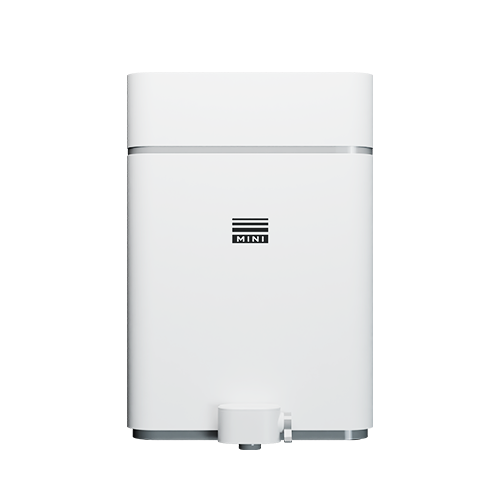
FIN Mini: built for exactly this water
Tankless Permionics ultrafiltration that removes bacteria, viruses and sediment while keeping 100% of the minerals BMC water arrives with. Zero water wastage, zero electricity — because low-TDS water never needed an RO pump. Backed by a 2-year unconditional warranty covering every part, filters included.
Read more: Mumbai water, explained
Short, sourced reads on what's actually in your supply — and what to do about it.
Why Mumbai doesn't need RO: the TDS numbers
BMC water tests at 60–190 mg/L — far below the level RO was built for. Here's what your TDS meter is really telling you.
Read →The seven lakes: where your water actually comes from
Bhatsa alone supplies over half of Mumbai's daily 3,800 million litres. A tour of the catchments, the treatment, and the journey to your tap.
Read →What RO strips out — and why your body misses it
Calcium and magnesium in drinking water aren't a bug, they're a feature. What the research says about demineralised water.
Read →Monsoon water safety in Mumbai buildings
Pipeline pressure drops and overflowing tanks make monsoon the riskiest season for tap water. A society-level checklist.
Read →UF membranes, explained in two minutes
How a 0.01-micron hollow-fibre membrane removes bacteria and cysts while letting dissolved minerals pass straight through.
Read →How to test your own tap (and tank) properly
A TDS meter costs less than a pizza. What to test, when to test it, and when to send a sample to a lab instead.
Read →Questions Mumbaikars actually ask
My TDS meter shows 100. Is that too low?
No — that's typical, healthy BMC water. TDS between 60 and 190 mg/L is well within the range considered good for drinking. Low TDS is not a problem to fix; it's the reason you don't need an RO.
If BMC water is treated, why do I need any purifier?
Because treatment happens at the plant, and your tap is many kilometres of aging pipeline and one building tank away. Contamination along the way is microbial — bacteria, viruses, cysts, sediment — which is exactly what UF filtration removes.
The purifier salesman says I need RO. Is he wrong?
For pure BMC/NMMC/TMC supply, yes. RO is built for dissolved-solids problems (500+ mg/L groundwater). On low-TDS lake water it strips the calcium and magnesium your water arrives with, wastes 2–3 litres for every litre purified, and needs electricity — all to solve a problem Mumbai's supply doesn't have.
My building mixes tanker or borewell water. What then?
That changes things — mixed supply can push TDS well above municipal levels. Test your tap first. If it consistently reads above ~300–500 mg/L, an RO becomes reasonable. If it stays low, UF remains the right choice.
Does UF remove chlorine taste?
UF membranes target particles and microbes; a carbon stage in the purifier handles chlorine and odour. FIN Mini includes both, so the water tastes the way lake water should.
How often do filters need changing?
Typically once a year for a Mumbai household, depending on sediment load. FIN's 2-year unconditional warranty covers every part — filters included.
Data sources
Disclaimer: Figures are indicative readings for BMC/NMMC/TMC supply areas and can vary by pipeline age, building storage and season. They are not a substitute for a lab test of your own tap. This page is general information, not medical advice; product suggestions are general guidance, not a diagnosis of your supply. For health concerns, consult a qualified professional.